How smoke and bomb interactions from recent patches change team executes in ranked play
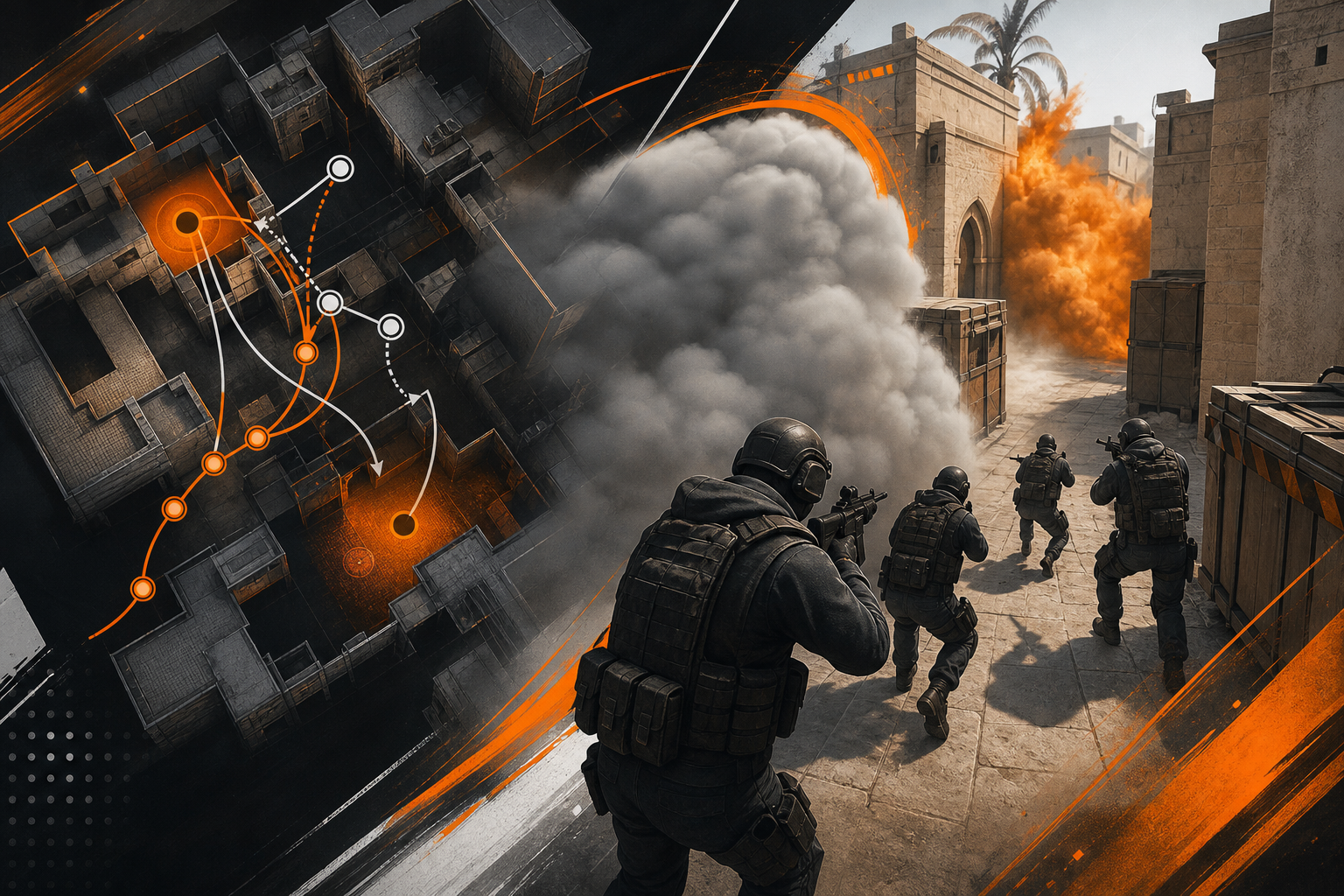
Ranked executes depend on more than whether a team has smoke: they depend on when cover arrives, where it lands, how long it holds, and whether teammates can act on the same timing. In Call of Duty: Warzone, recent Smoke Screen changes make smoke-based team executes more controllable, while updates in other competitive games underline an important limit: smoke can enable a play, but it does not remove counterplay or timing risk.
For ranked teams, the practical adjustment is to treat smoke as a scheduled part of the execute rather than a last-second visual screen. The Warzone changes are especially concrete: Smoke Screen became faster to deploy, more extensive, longer lasting, and available in Ranked Play. Those changes affect the choices a squad can make around a crossing or attack, but they do not guarantee a safe route, a successful entry, or a favorable bomb-site outcome in games with plant objectives.
What smoke and bomb interactions change in ranked executes
Direct answer: Smoke changes the conditions for an execute by obscuring sightlines and creating a window for movement, entry, or a post-plant setup. Faster deployment, broader coverage, longer duration, and greater availability can make that window easier to coordinate; teams still need to time movement, account for counters, and keep a plan for when the cover ends.
That distinction matters because an execute is a sequence, not a single utility use. In a bomb-objective game, the sequence may involve approaching a site, blocking defenders’ views, entering, planting, and setting up to defend the objective. In Warzone, the same planning logic applies to coordinated movement and tactical plays, even though the supplied Smoke Screen patch details do not describe a bomb plant. The common question is how a team converts temporary visual cover into useful action.
A patch can change that conversion in several ways. If deployment takes less time, the squad has less time to stand exposed while waiting for cover. If smoke reaches more positions or lasts longer, players may have a wider or more durable movement window. If the tool becomes available in a ranked loot pool, teams can consider it more often,but availability is not the same as a guaranteed pick or a guaranteed plan.
- Timing: Can the team begin its move when the cover is actually arriving?
- Coverage: Does the smoke cover the route or position the team intends to use?
- Follow-through: Is there a clear entry, crossing, objective, or fallback action during the smoke window?
- Counterplay: What will the team do if an opponent can see, challenge, or wait out the covered approach?
These questions are more useful than treating smoke as an automatic invitation to push. A team can spend utility and still gain little if the smoke lands away from the intended route, arrives before players are ready, or expires before the next action is complete. The recent Warzone changes improve parts of that execution problem; they do not solve every part of it.
How Warzone Smoke Screen patches changed the execute timeline
The most significant Warzone change is not simply that Smoke Screen produces cover. It is that the sequence became more predictable and more flexible across several updates. Season 02 Reloaded changed the way the killstreak deployed: it began at the targeted location, followed a line parallel to the player’s facing direction, and continued through five impacts. The deployment delay also fell from 5.25 seconds to 2.5 seconds.
The developers described the aim as making it easier to create cover exactly where and when it was needed for tactical plays. That is a meaningful execute change. A squad can think about the direction it is facing and the line it wants covered, rather than relying only on a vague expectation that smoke will appear somewhere useful. The shorter delay also reduces the gap between calling for the tool and the beginning of its effect.
Season 03 Reloaded then expanded the cover window and coverage. Smoke Screen duration increased from 7 seconds to 12 seconds, the number of deployed smokes rose from 5 to 9, the spread became more diagonal, and the delay before smoke hit the ground was reduced. The patch notes described the adjustments as intended to make Smoke Screen a more viable and impactful tool for cover and tactical executes.
In practical terms, the changes give a team more room to plan around the smoke pattern: where it starts, how it spreads, when it arrives, and how long the resulting cover can support movement.
Each adjustment affects a different planning constraint. The reduced deployment delay helps with responsiveness. The longer duration gives a team more time to complete a planned action, although the team still has to judge whether its own movement and follow-up fit inside that window. More impacts and a more diagonal spread change the coverage pattern, which makes it important to rehearse the intended use instead of assuming that every deployment will create the same usable lane.
Turn the patch notes into a timing call
A useful comms plan separates the moment of deployment from the moment of movement. One player should make the intended direction or target clear, while teammates confirm whether they are moving immediately, waiting for the smoke to land, or holding until a second cue. This is not a claim that one call sequence is correct for every squad. It is a way to avoid treating deployment as synonymous with permission to move.
Teams should also account for the difference between smoke appearing and a route being usable. Smoke can be in the process of deploying while players are still exposed or out of position. The patch reduced delays, but the notes do not say that the effect is instantaneous or that it blocks every possible line of sight. Practice should therefore focus on observing the actual timing and pattern in the current build.
Plan smoke around the action, not around the visual effect
When a team plans an execute, begin with the action it needs to complete. That might be a coordinated crossing, an entry into a contested area, or a plant and post-plant setup in a game built around a bomb objective. Only then should the team decide what the smoke needs to cover and when it needs to arrive. Starting with the visual effect can leave players with attractive cover that does not support the objective.
- Name the objective. State what the team is trying to do during the smoke window: cross, enter, take a position, plant, or create a safer reset.
- Choose the covered route. Identify the line or area that needs concealment. In Warzone, consider the Smoke Screen direction and spread documented in the patch notes rather than assuming a circular screen.
- Assign a timing cue. Decide whether movement starts on deployment, on visible contact with the ground, or on a teammate’s call. A consistent cue helps players avoid splitting between early and late movement.
- Assign the next job. Give players a role after the crossing or entry, such as continuing the objective, watching a likely approach, or preserving a fallback route. The smoke itself does not complete those jobs.
- Set a fallback. Agree what to do if the smoke does not cover the intended path, the opponent contests the approach, or the team cannot finish before the cover window closes.
This sequence makes the interaction between smoke and a bomb objective easier to understand. Smoke is valuable when it supports an objective action, not merely when it makes a site or route look obscured. In a plant-based game, the squad should know who is responsible for reaching the objective and what teammates will do while that player acts. The specific roles and mechanics differ by game, so teams should use their game’s current rules rather than importing Warzone assumptions.
Use duration as a planning boundary
Warzone’s Season 03 Reloaded increase from 7 seconds to 12 seconds lengthened the stated Smoke Screen duration. Teams can use that change to reconsider the length of an intended movement sequence, but should not interpret 12 seconds as a universal safe window. The patch fact describes duration; it does not establish that all parts of a route remain safe for that entire period or that opponents cannot respond.
A sound practice is to rehearse both the intended sequence and the end of the sequence. Players should know whether they are continuing forward, holding a position, or disengaging when cover fades. That gives the team a decision point instead of letting everyone assume that the smoke will last long enough for an unplanned extension.
What Ranked availability changes for Warzone teams
Season 04 Reloaded added Smoke Screen to the Ranked Play loot pool. The patch notes said this diversified available killstreaks in Ranked and brought Ranked more in line with other playlists. For teams, the key implication is strategic availability: smoke can become part of the ranked conversation because it is in the pool, rather than being a tool that only matters in a different playlist.
That does not mean every squad will have Smoke Screen in every situation. A loot-pool addition changes what can be available; it does not establish how often an individual team will obtain it, whether it will be the best choice in a particular match, or whether teammates can coordinate around it. Treat it as an option to evaluate, not a guaranteed resource in the team’s starting plan.
When the squad does have the tool, it can ask whether the execute benefits more from immediate cover or from a different available killstreak. That decision should reflect the team’s position and goal. For example, smoke may be worth considering when a planned movement needs visual concealment, while a team with no clear route or no follow-up action may gain little from spending attention on a smoke-based play. The point is not to prescribe a universal pick priority; the patch facts do not provide one.
Ranked context makes repeatability important
Season 06 was described as a shorter Ranked season used to test meaningful changes. Its notes also said the team wanted top-ladder progression to reflect consistent performance rather than time played alone. That context matters to execute planning: in a tighter competitive environment, a change that makes an action easier to repeat can influence how teams prepare and evaluate their decisions.
This is a strategic implication, not evidence that Smoke Screen alone changes ladder outcomes. A tool with clearer deployment and expanded cover can give teams another coordinated option, but consistency still depends on player decisions, communication, and adapting to the situation. Teams should judge the value of the tool through repeatable practice and match review, not by assuming that a patch buff automatically produces better results.
For coaches and analysts, the review question should be specific: did the team get the intended movement or objective action from the smoke? Separate that from whether the round or fight was ultimately won. A successful execute can still end in a loss for reasons that happen afterward; an unsuccessful result can still include a well-timed, well-placed use. Separating execution quality from the final outcome helps avoid drawing too much from one play.
Smoke can support a bomb execute, but it cannot remove counterplay
Smoke creates concealment and a temporary opportunity; opponents still have ways to contest the plan. The supplied Rainbow Six Siege update is a clear example of counterplay remaining part of the balance. Y11S1.3 increased Glance Smart Glasses’ maximum duration so Warden could counter smoke- and flash-based executes more reliably. The adjustment shows that smoke-heavy site hits remain a live balance concern, while also showing why attackers should not equate smoke with guaranteed denial.
In practical terms, an execute plan needs a response to a defender who can challenge the covered approach. The team may need to vary timing, preserve another route, or be ready to stop rather than continue into a contested position. Those are general planning options, not claims about specific operator interactions beyond the Warden change provided. The right choice depends on the game, map, team composition, and current rules.
There is a second kind of counterplay risk: the effect may not behave as expected. The 2026 patch-history entry for Rainbow Six Siege notes propagation issues for Smoke’s Remote Gas Grenade on several maps. That is a different gadget from Warzone’s Smoke Screen, but it illustrates a broader operational point: ability behavior and map interactions can affect execute consistency. Teams should verify current behavior in the relevant game and version rather than relying indefinitely on an old practice routine.
- Do not assume smoke blocks every opponent’s information or response.
- Keep a plan for a challenged route or a delayed entry.
- Check the live game behavior after relevant balance or bug-fix updates.
- Review whether the tool created the intended opportunity, rather than merely noting that it was used.
Smoke is most dependable when the team treats it as one layer in a broader execute. If the plan depends entirely on an opponent being unable to respond, the plan is fragile. If smoke instead creates a window for coordinated movement while teammates remain ready to adapt, the team has more than one way to continue.
What other games show about smoke, objectives, and patch interpretation
Different games provide useful context, but they should not be collapsed into one universal smoke rule. Riot’s older description of Brimstone as being all about the big site execute moment offers a foundational framing for VALORANT: smokes can be part of a coordinated site attack and the post-plant plan. That supports the general idea that stronger or longer-lasting smoke can improve the reliability of a coordinated entry or setup, but it is not evidence of a recent smoke-specific VALORANT change.
Recent VALORANT patch notes identified here, including Patch Notes 13.08 and 13.02, show ongoing work on the game and ranked ecosystem. However, the available research did not identify a recent official smoke-interaction change comparable to the detailed Warzone Smoke Screen updates. Teams should not attribute a new smoke buff to those notes without a specific official change to support it.
PUBG supplies another relevant example of a smoke mechanic changing a cover window. Update 42.1 says dispersed smoke will gradually refill after a short period if its duration has not expired. For ranked teams, that creates a reason to reconsider how they chain smokes for crossings or late-round executes. It does not mean a team can count on unlimited concealment: the stated refill condition is tied to the smoke’s duration not having expired.
Apex Legends adds a different angle. The Overclocked patch notes mention improved interaction between Hardlight and other objects, preventing unintended destruction of some Legend abilities. That is not a smoke-specific execute buff. It does show that object-to-ability interactions remain an active design concern, which is relevant when teams build plans around abilities interacting with the environment.
Across these games, the useful comparison is not that every patch makes smoke stronger. Instead, patches can change the reliability, timing, availability, or interaction rules of a utility tool. Read the actual mechanic before changing a playbook: Warzone changed Smoke Screen’s deployment and coverage, PUBG changed smoke refill behavior, Siege adjusted a smoke counter and has documented gadget propagation issues, and the cited VALORANT and Apex facts do not establish a matching smoke buff.
Build a ranked practice and review loop around the patch
Teams should turn patch information into a small number of observable practice questions. That keeps preparation grounded in the actual change and avoids overhauling a playbook based on a line. For Warzone, the relevant variables are deployment delay, direction, impact pattern, spread, duration, and Ranked availability. For other titles, use the variables their own patch notes actually specify.
Before a match or practice block
Confirm the current version and the tool’s current behavior before rehearsing a fixed timing. Patch descriptions tell teams what changed, but they do not replace observing the effect in play. Make sure the players who call and use the tool understand the intended direction, the movement cue, and the action expected while cover is active.
Then create a short execute call that includes four pieces of information: the objective, the route or area to cover, the movement cue, and the fallback. Keep it concise enough for ranked communication. The purpose is not to add more words to voice comms; it is to make sure teammates share the same plan before the tool is used.
During review
Separate mechanics from decisions. First ask whether the tool behaved as expected: did it deploy in the intended direction, did the spread cover the desired area, and did the duration support the planned sequence? Then ask whether the team used the resulting window well: did players move together, did the objective player have support, and did the squad respond when the situation changed?
That separation matters for technical staff as well as players. A deployment or propagation issue is not the same diagnosis as a late call or a split entry. Where a game has known interaction bugs, map-specific behavior, or a recently changed duration, record the conditions and check whether the problem is repeatable before changing the entire tactic.
- Keep: A call or route that reliably produces the intended movement opportunity.
- Adjust: A timing cue that causes players to move before cover arrives or after the useful window has passed.
- Retire: A routine that depends on a mechanic no longer supported by the current patch or on cover that opponents can consistently contest.
For platform engineers and competition operations staff, the same discipline applies at a different level: keep patch and environment information clear, and avoid presenting one game’s mechanic as a cross-title guarantee. The supplied updates concern distinct systems. Accurate version notes and clear communication help teams, editors, and organizers discuss what a change does without implying that it changes another title’s rules.
Make the execute robust when the smoke window changes
A resilient ranked execute should still make sense if the smoke arrives late, covers less of the intended path than expected, or ends before every player reaches the next position. That does not require abandoning smoke; it means designing a plan with a usable decision point. A team can agree in advance when it will continue, pause, or switch to a fallback instead of making that choice only after the screen fills.
In Warzone, this is especially relevant because the patch changes alter several dimensions at once. Season 02 Reloaded changed deployment direction and delay; Season 03 Reloaded changed duration, number of smokes, spread, and ground-impact delay; Season 04 Reloaded added the tool to Ranked’s loot pool. Teams should test the combined behavior rather than assume that each change can be evaluated in isolation during a live execute.
The same principle applies to bomb-site play in other games, although the exact interactions differ. A smoke that supports an entry may also affect how the team approaches the plant and the post-plant setup. The team should decide how it will transition from concealed movement to objective control, because the transition is where a smoke-based plan can become disorganized if players have not assigned their next jobs.
There are also good reasons not to use smoke. If the team lacks a clear route, cannot coordinate the timing, or has a better option for the immediate situation, forcing a smoke execute may add complexity without improving the plan. The recent Warzone changes make Smoke Screen more usable and more available in Ranked; they do not establish that it is always the correct choice.
Finally, treat changes as inputs to review rather than as automatic prescriptions. The patch notes can identify what became faster, longer, broader, or more available. Team practice determines whether those changes support a particular route and communication style, while match review shows whether the plan remains useful against opponents who adapt. That process is more dependable than copying a single smoke pattern without checking the conditions around it.
The clearest ranked takeaway is to plan smoke around a defined action, not around the hope that visual cover will solve the execute. Warzone’s recent Smoke Screen changes make that tool more responsive and flexible, and its addition to Ranked Play makes it a more relevant option for squad planning. The value still comes from timing, coverage, teamwork, and a prepared response to counterplay.
For each patch, update the playbook only after confirming what changed and testing how it affects the team’s real execute sequence. Keep the calls simple, make the fallback explicit, and review whether smoke created the intended objective window. That approach turns patch changes into repeatable ranked decisions without treating any single utility tool as a guaranteed win condition.


