Adapting five-man tactics to randomized map picks and silent reloads
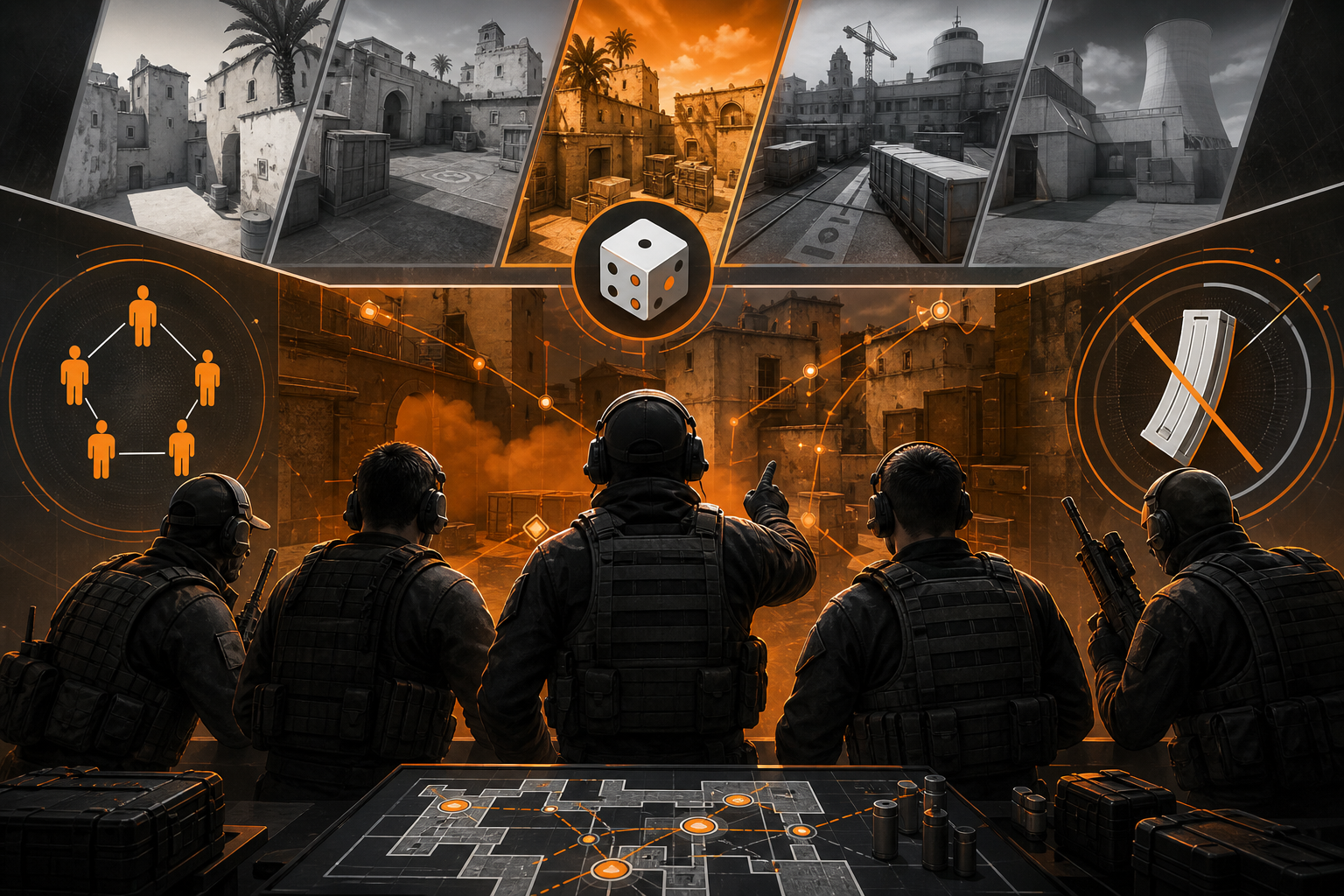
Valve’s September 22, 2026 Counter-Strike 2 update changes the tactical baseline in two separate ways at once: Premier map selection now uses a four-map pick structure with one random map chosen for the match, and players can perform silent reloads by holding the reload key. For teams that build around five-man structure, these are not cosmetic tweaks. They alter preparation, information flow, and the value of discipline under pressure.
For competitive teams, platform engineers, and event operators, the practical question is not whether the patch is different, but how it changes decision-making before a round even starts. A system that introduces partial randomization into map selection and reduces audio information in live play pushes teams toward broader preparation, cleaner protocols, and tighter timing standards.
What the new Premier selection model changes
Under the new Premier flow, Team 1 picks one map, Team 2 picks two, Team 1 picks a final map, and then one of those four is randomly selected for the match. That structure is materially different from a pure veto system, because the final outcome is no longer fully controlled by elimination. Once the four candidates are locked in, the match can land on any of them.
Valve’s stated design intent was to give players more opportunities to play maps they have been learning. From a competitive operations perspective, that means the pool is now less about avoiding weakness and more about demonstrating readiness across a broader set of environments. Teams can still influence the outcome, but they cannot fully engineer it.
Community coverage on September 23, 2026 reflected the same assessment: the map result is now partially randomized, and that alone makes the change a major tactical shift. For five-man tactics, the impact is immediate. Every premade map pool now carries a real chance of being played once the four choices are set.
Why five-man tactics must broaden map preparation
The most obvious strategic implication is that teams can no longer rely on banning away a weak map as easily. If a team has a fragile structure on one or two maps, the new selection model makes that weakness harder to hide. The correct response is not to hope the randomizer cooperates, but to reduce the gap between the best and worst maps in the pool.
A plausible adaptation is to broaden practice across the full active pool rather than over-optimizing only veto-favored maps. In a five-man system, that means more than learning utility lineups. It means rehearsing default spacing, opening contact rules, mid-round roles, and late-round conversion plans on every map that could realistically appear.
Roster depth matters more as well. If a squad’s IGL and support pieces can run the same macro concepts across multiple maps, the team becomes less exposed to random selection. The more transferable the five-man structure is, the less any single map can destabilize the whole game plan.
Adapting defaults to random map outcomes
Five-man tactics are usually strongest when the team can predict the map and prebuild defaults around it. The new Premier system weakens that certainty. Instead of treating the veto as a filter that guarantees comfort, teams need defaults that are portable, fast to tune, and not dependent on one specific geography.
That means the default should become the stable unit, not the map-specific gimmick. Openers should be designed around information gathering, trading efficiency, and utility conversion patterns that can be re-skinned across maps. Teams that can preserve structure while changing only the location of their pressure points will adapt fastest.
From an analytical standpoint, coaches should track which tactical pieces survive map changes and which do not. If a mid-round split works on three maps but collapses on two others, it needs a more generic backbone. Randomized picks reward repeatable systems, not just high-variance setups that only function on a narrow map subset.
Silent reloads and the new information economy
Valve also added silent reloads in CS2: players can reload quietly by holding the reload key, but the reload takes longer. The update notes make the tradeoff explicit. This is not a free stealth mechanic; it is a delayed action that buys concealment at the cost of tempo. Valve also made unscoping a sniper weapon silent, extending the same logic to a second class of audio information.
At high level, sound cues are part of the decision tree. Opponents use them to time pushes, count vulnerability windows, and identify when a player is temporarily committed to a non-combat action. If a defender can reload without broadcasting it, the attacking side loses a small but meaningful piece of live information.
Community coverage quickly identified silent reloads as the patch’s most impactful pro-play change. That tracks with how modern CS is played: a single audio cue can decide whether a team clears aggressively, waits for a mistake, or commits to a trade. Reducing that cue changes how both sides value patience.
Timing discipline in holds, retakes, and clutches
Silent reloads increase the value of timing discipline and positional deception in late-round play. A player can conceal the sound of reloading, but the reload takes longer, so the decision becomes a tradeoff between stealth and exposure time. If a player reloads at the wrong moment, they may be quiet, but they are still occupied.
That creates new protocol questions for five-man teams. When should an anchor reload after first contact? When should a retaker clear space for a quiet reload? When should a clutch player preserve tempo instead of attempting stealth? These are not abstract questions; they affect whether a team wins a 2v2 or bleeds the round to timing.
Teams should therefore create explicit coordination rules. A common approach would be to define reload windows after utility impact, after confirmed positional advantage, or during teammate crossfires. The goal is to make reloads intentional rather than reactive, especially in scenarios where the opponent is likely to punish any loss of tempo.
Set-piece protocols for quieter utility turns
Silent reloads also suggest a broader shift in how teams manage set pieces. A plausible five-man adaptation is to build protocols for “silent” utility turns, anchor resets, and post-contact reload timing. In other words, reloads should be treated like utility usage: planned, sequenced, and synchronized with team movement.
That matters because the information reduction is not symmetrical across all phases. During holds, a quiet reload can help a defender stay hidden. During retakes, it can prevent an attacker from hearing a defender reset. During clutches, it can allow a player to fake readiness while repositioning the opponent’s expectations.
For analysts, the key metric is not whether reloads are silent, but whether teams are using the extra concealment to create meaningful tactical edges. If silent reloads are only used as a convenience, their value is limited. If they are integrated into site protocols, they become another layer of positional control.
How to train for a more randomized competitive layer
Valve’s broader direction in the same patch reinforces the trend. The new Rush mode introduced alongside the update is a fast-paced queued 3v3 mode with randomly selected battle arenas, which shows a clear move toward more randomized competitive variety. That does not directly change Premier, but it does signal a design philosophy: players should be comfortable adapting to less predictable competitive conditions.
For teams and practice staff, the response should be to harden fundamentals. Scrim blocks should include full-pool map rotation, limited-information drills, and late-round communication exercises where sound cues are intentionally reduced. Teams that practice only their comfort zones will be the first to suffer when randomness exposes weak preparation.
Competition organizers and technical staff should also consider how their support systems reflect the new environment. Map-specific prep tools, replay analysis, and communication review should all emphasize adaptability rather than just historical win rates. The new patch rewards teams that can carry structure across uncertainty.
Operational takeaways for teams and staff
The safest conclusion is that five-man tactics now need to be more robust on two fronts: map coverage and information discipline. Randomized map picks mean you cannot rely on veto logic to protect your weakest environment, and silent reloads mean sound-based decision-making is slightly less reliable than before. Both changes push the game toward preparation depth.
In practical terms, teams should audit their map pool, identify where their default structures break down, and build standard responses for those pressure points. They should also formalize reload timing rules so the team knows when silence is valuable and when the longer animation is too costly. The best adaptation is not reactive improvisation; it is repeatable process.
For QuickFrag’s audience, the lesson is straightforward: the patch rewards teams that treat tactical flexibility as infrastructure. If the map can be randomized and the reload can be hidden, then preparation, coordination, and timing become the real competitive advantage.