Gain the upper hand as a team: rotations, signals, and utility inspired by the pro meta
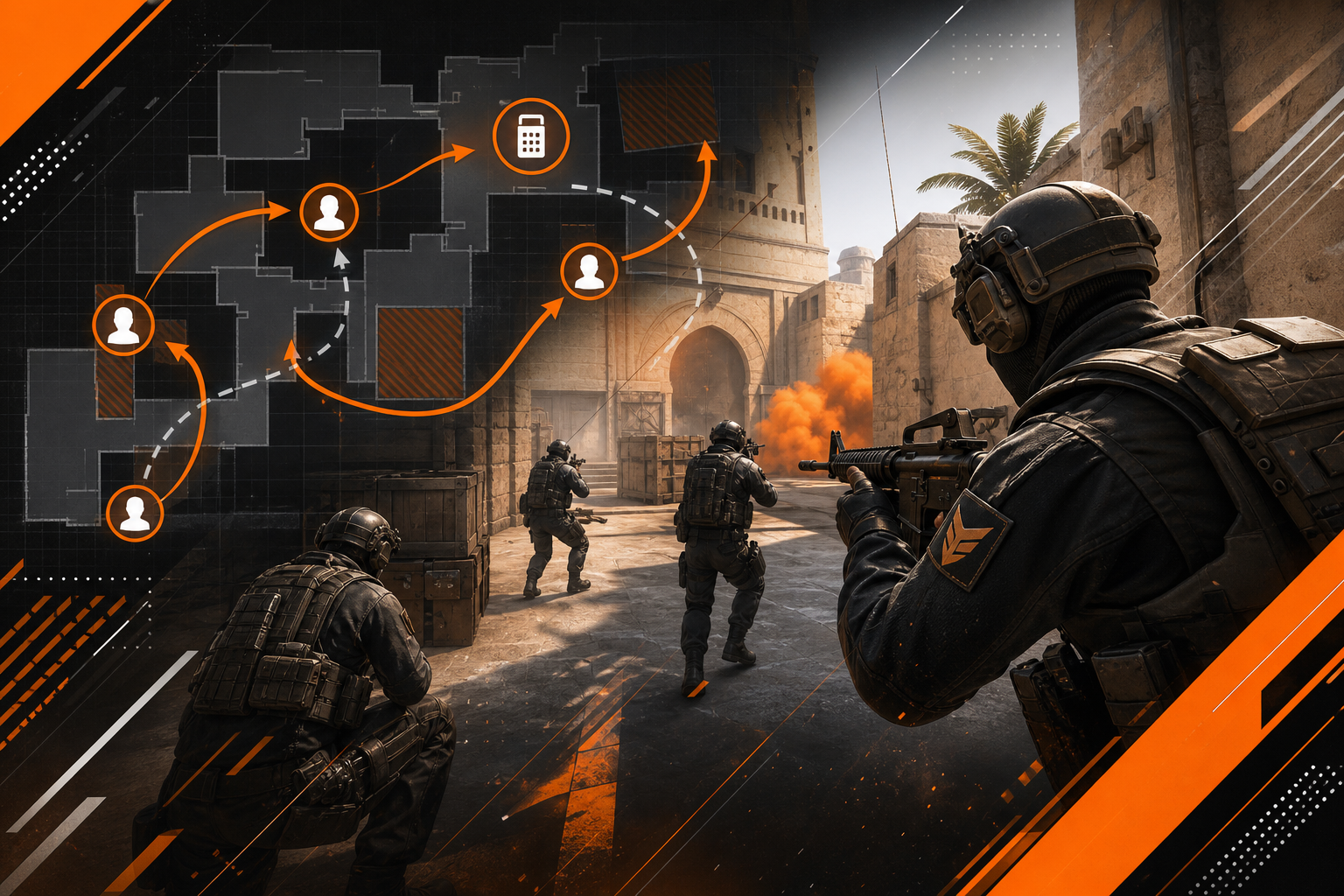
In the 2026 pro meta, gaining an advantage is no longer achieved solely through better aim or cleaner execution timing. It is also earned through the quality of rotations, the readability of utility signals, and a team’s ability to turn information into useful movement. For coaching staffs, analysts, and organizers, this has a direct impact: the way a squad reads the map determines its decision-making speed, mid-round stability, and resistance to pressure.
Recent changes confirm this direction. Riot has clarified how controllable utility is read on the minimap, strengthened the connection between gunplay and abilities, and pushed several maps toward cleaner, less ambiguous rotations. In other words, the meta rewards teams capable of orchestrating short signals, clear responsibilities, and rapid transitions between taking space, falling back, and gathering information again.
1. What the 2026 meta changed in team reading
The starting point is simple: Riot has made utility easier to read and exploit during matches. Since Season 2026, the icons for certain controllable utilities and drones have displayed direction, allied/enemy colors, and even pursuit status for certain behaviors more clearly. In practice, this reduces the team’s cognitive load and improves the quality of real-time calls, especially when several players gather information simultaneously.
This clarification is not merely cosmetic. It is part of the stated aim of creating a “healthy dialogue” between weapons and abilities, with clear ways to respond and adapt from round to round. Riot has also acknowledged that poorly coordinated utility could sometimes matter as much as a good strategic execution. For a team, this means that a good plan is not enough: a shared reading protocol is required.
In practice, the most effective teams are those that use the minimap as a decision-making interface, not as a simple passive indicator. Utility signals must trigger a hierarchy of actions: who rotates, who holds space, who gathers information, and who prepares the trade. The more roles are assigned in advance, the more automatic the rotation becomes, and the less it depends on costly improvisation.
2. Rotations: reducing the delay between information and movement
Modern rotation is no longer just a race from one site to another. It is a validation sequence: information is received, cross-checked, and then converted into movement. The 2026 map changes follow this direction, reducing angle complexity, making open spaces more manageable, and improving defender rotation times on certain maps. This favors teams that know how to read the round’s tempo without overreacting.
Changes to the map pool also show that this dynamic remains fluid. Breeze was completely reworked for Season 2026 and later removed from the competitive pool, reminding us that rotation priorities can change quickly. A team that simply memorizes routes becomes less effective as soon as a structural change alters sightlines or contact points.
For coaches, the right objective is not to make the team “run” faster, but to reduce the delay between the first signal and the defensive or offensive commitment. This requires simple rules: one primary call, one confirmation call, and then one execution call. The shorter the chain, the more reliable the rotation becomes, even under pressure or with incomplete timings.
3. Utility signals: standardizing the language before the round
The strongest utilities are not necessarily those that deal the most damage. They are often the ones that impose a shared language on the entire team. Riot demonstrated this with Tejo, whose adjustments were explicitly intended to clarify when to deploy certain guided salvos and how to play around his drone and reconnaissance interactions. The message is clear: an ability’s effectiveness also depends on the quality of the call chain surrounding it.
This has direct implications for the structure of scrims and official matches. If a drone, smoke, or projectile requires a different interpretation depending on which player deploys it, the team loses speed and consistency. By contrast, if every signal is codified,“scan,” “force,” “delay,” “retake,” “reset”,the reading becomes automatic. The team no longer debates intent during the round; it executes an already-known response.
The 2026 patching philosophy also follows this logic of transparency. Riot has clarified the states of certain controls on the minimap specifically so that collective decision-making can be more precise. From an esports perspective, this means that a staff can build playbooks around observable, reproducible, and auditable cues, which is essential for coaching, video analysis, and opponent preparation.
4. Space, timing, and the value of aggressive utility
Aggressive utility is not meant to be merely “loud.” Its purpose is to create a window of advantage, not simply to force a reaction. Riot stated this very clearly with Harbor: his 2026 buffs were intended to increase advantage windows when an enemy is hit by his offensive utility. This confirms a strong direction for the meta: utility must produce a measurable shift in the balance of power.
With this logic in mind, the proper use of aggressive utility should be judged by its ability to trigger a predictable enemy movement. If the opposing team falls back, splits up, or loses its trade timing, then the space gained is real. If it remains compact and maintains its structure, the utility has been wasted. The criterion is therefore not solely the kill, but the change in the opponent’s behavior.
This approach is particularly important for teams playing online, in international scrims, or on infrastructure with variable latency. The less a decision relies on pure instantaneous reactions, the more the quality of the execution plan matters. Utility must therefore be designed as a tempo lever, capable of opening a movement corridor and securing a transition before the opponent can reorganize.
5. Pro case study: Yoru, information, and global rotation
Riot explicitly identified Yoru as a map-wide rotation problem, highlighting his ability to project an advantage across the entire map through extremely strong space-taking and a highly versatile flash. This observation is essential, because it shows that in pro play, an agent’s value is not limited to local impact. A tool that threatens multiple areas at once disrupts defensive reading, even without direct contact.
For teams, this changes the way defense must be played. It is no longer enough to cover an entrance or hold an angle; teams must assess what the opponent can threaten from a distance and when a fake rotation becomes credible. A well-used Yoru forces defenders to preserve response options: delaying utility, minimal repositioning, and discipline against over-rotating.
Counterplay therefore relies on structuring information. Once a team understands that an agent can shift the threat without fully exposing himself, it must avoid panicking. A good protocol is to require two independent signals before breaking the defensive structure: an indication of presence, followed by confirmation of commitment. This is exactly the type of discipline that the current meta rewards.
6. Maps, competitive pool, and continuous adaptation
Competitive play cannot be understood solely through agents; it must also be viewed through the map cycle. In 2026, Riot made major changes to one map to reduce angle complexity, tighten open spaces, and improve defender rotation times. Breeze was completely reworked in 12.00, reminding us that macro play can never be fixed if the map structure evolves.
Later, Breeze’s removal from the competitive pool and Abyss’s addition confirmed that map pool rotation is an integral part of preparation. The teams that perform best are those that maintain a tactical foundation that can be transferred from one map to another: communication standards, coverage principles, retake procedures, and utility economy management. The details change, but the execution model must remain stable.
Summit illustrates this trend even more clearly. Its structure, with droppable walls that alter the map during the round, forces teams to recalibrate timings, while its Retake mode reinforces the importance of coordinated returns under time pressure. This approach shows that Riot is pushing the game toward sequences that are more readable for teams capable of anticipating changes, not just those that “react quickly.”
7. Rules, integrity, and the limits of utility advantage
When utility becomes central, the rules must evolve as well. The 2026 Challengers regulations prohibit texture or geometry abuses that create unfair information or positioning advantages, and require utility to remain destructible and visible as intended. For organizers and technical teams, this is a critical point: the pro meta rewards creativity, but not the exploitation of a design loophole.
There are, however, tightly controlled exceptions, such as the one involving KAY/O, whose certain out-of-bounds placements are explicitly preserved as long as they do not exploit a geometry bug. This type of rule clearly demonstrates the level of detail required in competitive regulation. Staffs must know the exact limits to avoid drafting, setup, or regulatory review errors.
Beyond compliance, this rigor also protects the clarity of the competitive spectacle. If utility becomes opaque, impossible to contest, or ambiguous in its effects, decision quality declines and the meta loses its tactical appeal. By maintaining a clear boundary between legitimate innovation and abuse, Riot promotes an environment in which advantage is earned through coordination, not ambiguity.
In practice, gaining a team advantage in 2026 means mastering the information-rotation-utility trio. Map adjustments, clarified minimap signals, and buffs designed around advantage windows all point in the same direction: the winning team is the one that turns every ability into a fast, shared, and verifiable decision.
For esports teams, platform engineers, and competition staffs, the message is direct: standardize calls, reduce validation time, and design your protocols as a distributed system in which every player receives, interprets, and executes information at the right moment. In the current pro meta, advantage is not merely mechanical; it is organizational.