Optimize rotations and positioning after the overhaul of the explosion and Cache’s return
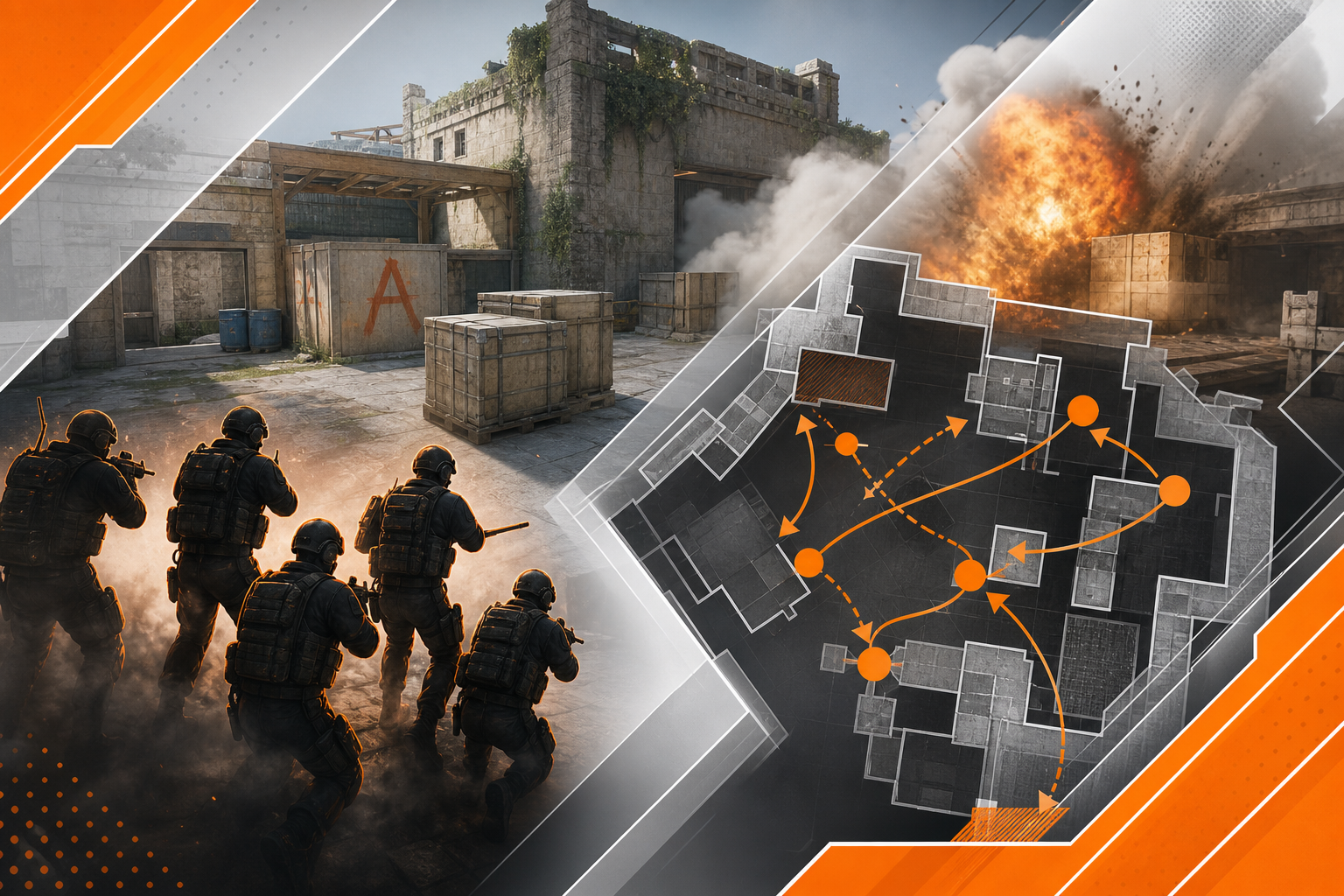
The return of Cache to the Active Duty map pool immediately reshuffled the competitive landscape. When Valve confirmed, in the July 8, 2026 update, that Cache would join the Active Duty group in place of Overpass, the way teams read rotations, timings, and survival zones had to be recalibrated almost overnight.
This shift coincides with the launch of Premier Season 5 and the rework of the C4 explosion, two factors that have made several habits built up on previous maps obsolete. For coaching staffs, analysts, and players, the challenge is no longer simply to “know the map,” but to rebuild reliable reference points around mid control, post-plant positioning, and the risks associated with the new blast zones.
Understanding the New Competitive Starting Point
The most important point is not Cache itself, but the context in which it is returning. Premier Season 5 begins at the same time as this integration, which implies an indirect reset of established habits: rotation routes, information timings, and site retake patterns are being observed in an environment where few teams yet have a stable track record.
Cache remains a very “skill-forward” map, making it particularly sensitive to clean execution. As soon as a map of this type changes status, the teams that gain an advantage quickly are those that standardize their protocols fast: who holds Mid, when the second player repositions, and what the decision threshold is for switching between site support and a more aggressive rotation.
In this context, overly rigid interpretations should be avoided. Reference points from Overpass or earlier versions of Cache do not translate mechanically, because the Source 2 rework, the successive patches of July 9, 2026, and August 3, 2026, as well as geometry adjustments, concretely alter paths, angles, and lines of sight.
Mid Control as the Backbone of CT Rotations
Recent analyses of Cache converge on one simple principle: control of the center of the map dictates the speed of rotations toward A or B. Defensively, this means that a CT setup should not rely on long rotations from one extreme of the map, but on a coherent network built around Mid and Connector.
An effective setup generally consists of one anchor per bombsite, a player dedicated to the middle, and a third player ready to provide support based on the information received. This structure reduces the downtime between gathering information and the arrival of reinforcements, which is essential on a map where losing a single duel in the center can open the way for a fast execution onto either site.
Connector is particularly critical, as it serves as the link between static defense and responsiveness. In practice, the teams that win the most rounds on Cache are not those that rotate earliest, but those that rotate from the right position, with enough coverage to avoid abandoning both sites too quickly.
Rethinking Positioning After the Explosion Rework
The C4 rework changes how “safe” positions are evaluated. Valve specified that damage is now applied through precomputed simulation values integrated into the compiled map, with propagation originating from the center of the explosion. In practical terms, danger assessment becomes more structured, less immediate, and more dependent on the actual geometry.
The tactical result is immediate: positions on the edge of the blast zone are more precise than before, but also more demanding to learn. The shockwave dissipates in corners and does not pass through walls, creating clear differences between a position that is theoretically close to danger and one that is actually exposed.
For teams, this requires a new mapping of post-plants and defensive anchors. Some spots once considered “just safe enough” must be revalidated frame by frame, especially in areas where geometric cover creates a false sense of security.
Adapting Post-Plants and Anchors on Cache
On Cache, the new explosion directly affects the quality of post-plant survivors. Since damage spreads from the center and loses intensity in corners, the composition of a post-plant duo should no longer focus solely on the ideal line of sight, but also on the position’s resilience against the blast zone and adjacent walls.
This particularly affects scenarios in which a player hides behind partial cover or in a niche intended to “absorb” part of the explosion. The new calculations make some shelters more reliable, while turning others into false havens of safety. On Cache, where retake timings are already fast, this difference can decide an entire round.
Defensive anchors must follow the same logic. A player holding a stopping angle must know not only their line of sight, but also the cost of repositioning when the bomb is planted. If the bomb has been planted and a retake is likely, the starting position must allow for a coherent exit without relying on a “lucky” timing against the blast radius.
Using the Updated Geometry Without Overplaying Angles
The July patches followed by the August 2026 updates mainly confirmed that Cache was not simply “back,” but still undergoing stabilization. Changes to geometry, collision, and visibility directly affect crosshairs, pre-aims, and defensive lines, particularly around A, Checkers, and B Main.
The practical consequence is simple: angles must be relearned from the current terrain, not from historical memory. A modified wall edge, a moved object, or a slightly adjusted line of sight can turn a 60/40 duel into unnecessary exposure. On this type of map, the most successful teams are often those that treat geometry as production data rather than scenery.
For coaching staffs, this means documenting holding spots with up-to-date screenshots, stable aiming references, and precise annotations on overpeek risks. The longer the map remains under reconstruction, the more calibration discipline becomes a competitive advantage.
Optimizing T-Side Rotations Around Information Windows
On the attacking side, Cache rewards fast but clean rotations. The goal is not to cross the map without a plan, but to exploit information windows in order to force the CTs to reveal their setup. A well-coordinated mid take often forces the defense to expose its weak point, which then opens an attacking rotation toward the less densely covered site.
Priority should therefore be given to sequences in which the team can confirm the presence or absence of CT control before triggering the rest of the round. On Cache, sending players too early without reading the situation leads to strong retake setups, whereas an attacking rotation based on a clear timing allows the team to punish late defensive repositioning.
The ideal pace combines pressure, information, and utility preservation. A team that can maintain a threat in the center while keeping its options open forces the CTs to choose between two bad options: staying compact and giving up space, or moving too early and weakening the defensive structure.
Managing Dropped Weapons and End-of-Round Situations
One detail often overlooked in strategic analysis concerns dropped weapons. The July 8, 2026 update specifies that the new C4 explosion exerts more force on weapons lying on the ground, which can change how a team secures a late-round duel or recovers equipment after a contested plant.
In a competitive environment, this parameter is not insignificant. A weapon moved by the explosion may leave a planned recovery area, disrupt a retake plan, or force a player to expose themselves further to retrieve it. On Cache, where end-of-round situations often depend heavily on micro-positioning, this should be incorporated into end-of-round protocols.
Teams should formalize simple rules: which weapons must be secured as a priority, who covers the recovery, and to what extent the risk of being displaced by the explosion changes behavior around the C4. This kind of detail, invisible on the scoreboard, can nevertheless swing several rounds in a series.
Building a Sustainable Cache Meta
Since August 2026, meta guides have emphasized that Cache remains under strategic reconstruction. Communities still describe it as a map undergoing optimization, with rotation, timing, and post-plant reference points becoming more refined as teams replay the map at a high level. This means that no playbook should be considered final.
The right approach is to industrialize adaptation. The teams that improve quickly on Cache are those that record their scrims, compare timings, document new retake windows, and test positioning under different explosion conditions. In other words, the map must be treated as a versioned system, not as a fixed routine.
For organizers and content creators, this period is also an opportunity: the return of Cache has created an immediate need for clear guides, visual reference points, and up-to-date analysis. The more Valve’s official sources on Counter-Strike.net are cross-referenced with precise field feedback, the more reliable the tactical understanding becomes.
Ultimately, optimizing rotations and positioning on Cache after the explosion rework means accepting a new discipline of analysis. The teams that progress fastest will be those that control Mid cleanly, reassess their spots in light of the new blast zone, and structure their rotations around verified information rather than inherited habits.
Cache is once again a map of execution, timing, and detail. During this transition phase, the competitive advantage belongs to those who know how to turn every patch into a working method, and then every working method into more consistent rounds.