How QuickFrag streamlines building a five-stack, from verified profiles to instant scrims
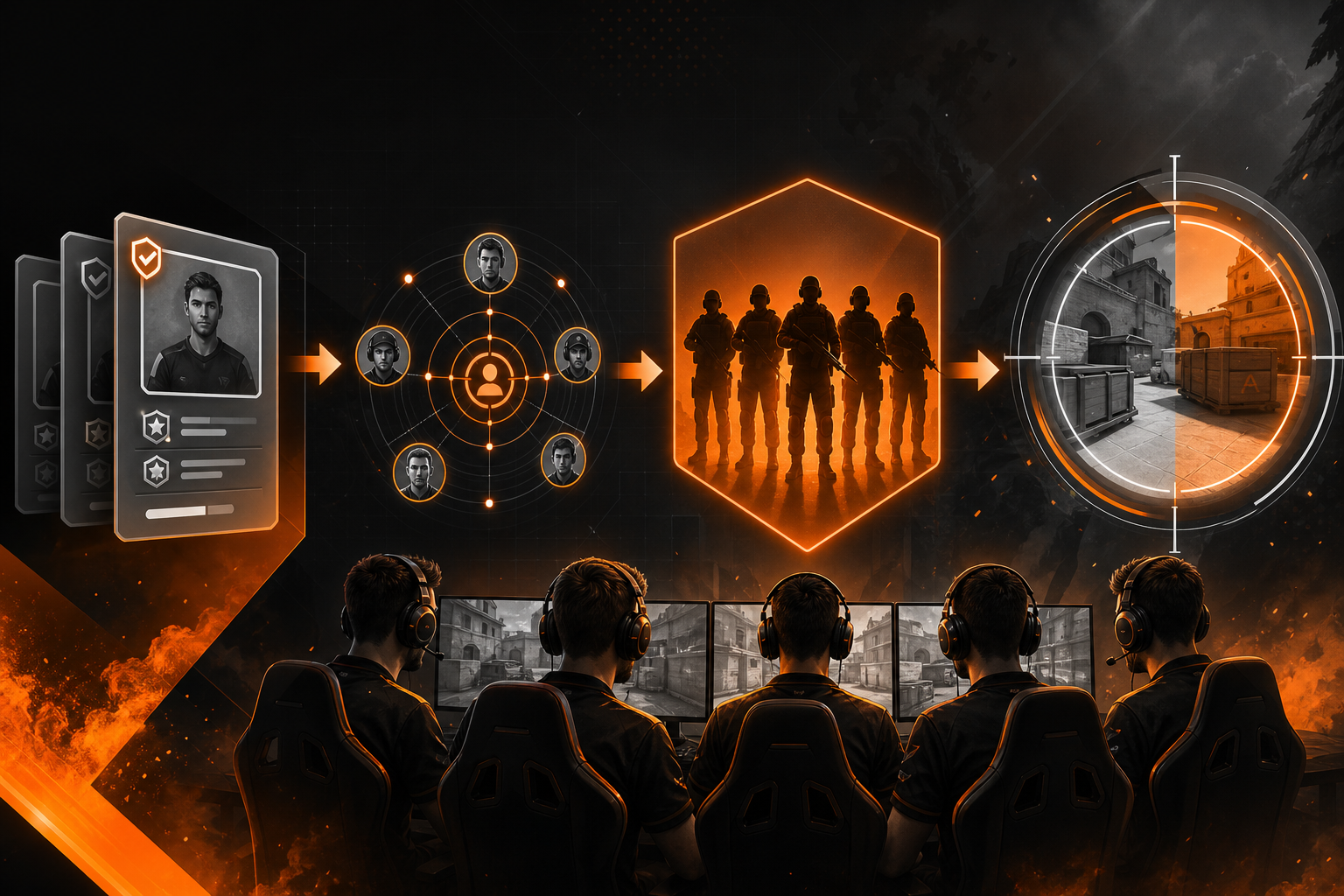
Building a reliable five-stack in CS2 is mostly a systems problem disguised as a social one. The hard part is rarely finding five players; it is coordinating identities, schedules, server access, match settings, and post-game review without turning every scrim night into admin work.
QuickFrag is positioned around that exact workflow. By combining verified Steam-based profiles, roster management, private scrim hosting, and demo review in one platform, it reduces the number of tools a team needs to keep a five-player unit active and repeatable.
Verified profiles create a trustworthy five-stack base
Any serious stack needs a dependable identity layer before it can be treated like a team. QuickFrag requires Steam authentication, which means player identities are verified rather than improvised, and the stats tied to those profiles are less likely to be polluted by throwaway accounts or untracked alternates.
That matters operationally. When roster decisions depend on performance, attendance, and consistency, the platform needs to preserve a stable record of who played, how they played, and how often they showed up. QuickFrag’s profile system is built for that, with persistent identity, rank, ELO, match history, statistics, achievements, progression, inventory, and activity stored across sessions.
For team staff, this reduces the amount of manual verification normally required before a scrim or tryout. Instead of cross-checking names in Discord and spreadsheets, organizers can rely on authenticated profiles and a shared historical record that follows the player through repeated matches.
Roster management and recruitment happen in one place
QuickFrag does not treat recruitment as a separate admin workflow. Its teams page says teams can run their roster, recruit players, and launch private scrims from the same environment, which is important for stacks that are still stabilizing or cycling through substitutes.
That integration changes how a five-stack is formed. A captain can track who is already in the roster, identify gaps in role coverage, and bring new players into the process without moving between recruiting channels, shared docs, and separate scrim tools. The result is less friction between scouting and practice.
This is especially useful for training teams and Discord communities that rotate participants. QuickFrag’s German product messaging explicitly positions the platform around coordinated match creation and structured player profiles for friend stacks, training teams, and scrim organizers, which makes it easier to treat the five-stack as a persistent unit instead of an ad hoc queue.
Instant scrim provisioning removes the scheduling bottleneck
The fastest way to lose a scrim night is to spend the first 20 minutes finding a server. QuickFrag’s core promise is that it can provision dedicated CS2 servers for private 5v5 scrims in under 60 seconds, which significantly changes the pacing of team practice.
That speed matters because five-stack sessions are usually time-boxed. If a team only has a few hours, every minute spent configuring IPs, connecting to rented infrastructure, or waiting for a host to finish setup reduces actual practice time. QuickFrag’s model is built to eliminate that dead time.
It also helps organize closed 10-player matches and stack nights without requiring a VPS rental or shared network exposure. By keeping provisioning internal and on-demand, the platform removes a layer of infrastructure management that usually belongs to platform engineers or the most technically fluent player on the roster.
Private scrims give stacks a controlled practice environment
Private lobbies are where a five-stack stops behaving like a casual queue and starts behaving like a unit. QuickFrag’s features page says private CS2 lobbies are designed for scrims, stack nights, and closed matches, which makes the platform suitable for controlled practice rather than public matchmaking only.
The value here is operational consistency. Teams can reuse the same settings, the same ruleset, and the same match structure while keeping outsiders out of the session. QuickFrag explicitly frames this as a way to host matches without renting a VPS or sharing IP addresses, both of which are recurring pain points for smaller teams.
Private scrims also give organizers a cleaner way to manage attendance and readiness. When the session is already a closed 10-player environment, it is easier to confirm who is in the room, who is substituting, and which side each player should start on before the first round begins.
Structured match settings turn casual groups into repeatable practice
A five-stack improves faster when every session follows a predictable format. QuickFrag emphasizes structured competition settings such as MR15 rules, map vote, and result tracking, which are the kind of controls that make scrims useful for development instead of just warm-up games.
Public matchmaking is also described as a fast path to a competitive 5v5 server, with ELO updates saved to the player profile after each game. That gives the platform a progression layer even when the group is not running a private scrim, and it helps players track whether the stack is improving over time.
For team staff and analysts, the important detail is that the match is not just played; it is recorded in a way that can be revisited. Result tracking and profile-linked outcomes support post-session review, lineup decisions, and basic competitive reporting without building a separate data pipeline.
Demo review closes the loop after the scrim
Five-stack building is not only about getting into a server quickly. It is also about extracting value from each session, and QuickFrag addresses that through Clip Studio, which lets teams upload scrim demo files and export per-player highlights.
That workflow is practical for both coaching and content operations. A team can review mistakes, identify repeat patterns, and pull clips for internal analysis without exporting data into a third-party editing chain. PeerPush’s review of the platform also notes that demo processing can support clips in 16:9 and 9:16 formats for YouTube, TikTok, Instagram Reels, Shorts, Discord, and similar destinations.
For a competitive stack, this is more than media convenience. When the same platform supports scrims and post-scrim review, the feedback loop gets shorter, and the team can move from one session to the next with fewer tools and fewer points of failure.
Why the platform architecture matters for team continuity
QuickFrag’s broader positioning is that it replaces fragmented tooling. Its team-facing language directly calls out the problem of juggling Discord, VPS rentals, and spreadsheets, and asks whether a stack can coordinate without five different apps.
That framing is important because five-stack continuity depends on more than player skill. A team needs a stable identity system, a reliable way to launch matches, a method to track results, and a review path after the game ends. QuickFrag centralizes those steps so the stack does not dissolve into administrative over.
The platform’s current messaging also suggests it is actively maintaining this product direction. Recent listings and crawl timestamps indicate that verified profiles and instant scrim provisioning are not legacy features buried in old documentation; they are part of the current public positioning for teams that want repeatable 5v5 operations.
For eSports teams, platform engineers, and competition organizers, the takeaway is straightforward: QuickFrag is designed to make the five-stack operational, not just social. By connecting verified profiles, roster management, instant dedicated servers, private scrims, and demo review, it turns a group of five players into a more durable practice unit.
That durability is the real efficiency gain. When the stack can be assembled, verified, launched, tracked, and reviewed in one workflow, the team spends less time coordinating infrastructure and more time improving play.