Master team roles and dynamic-smoke tactics to seize bombsites
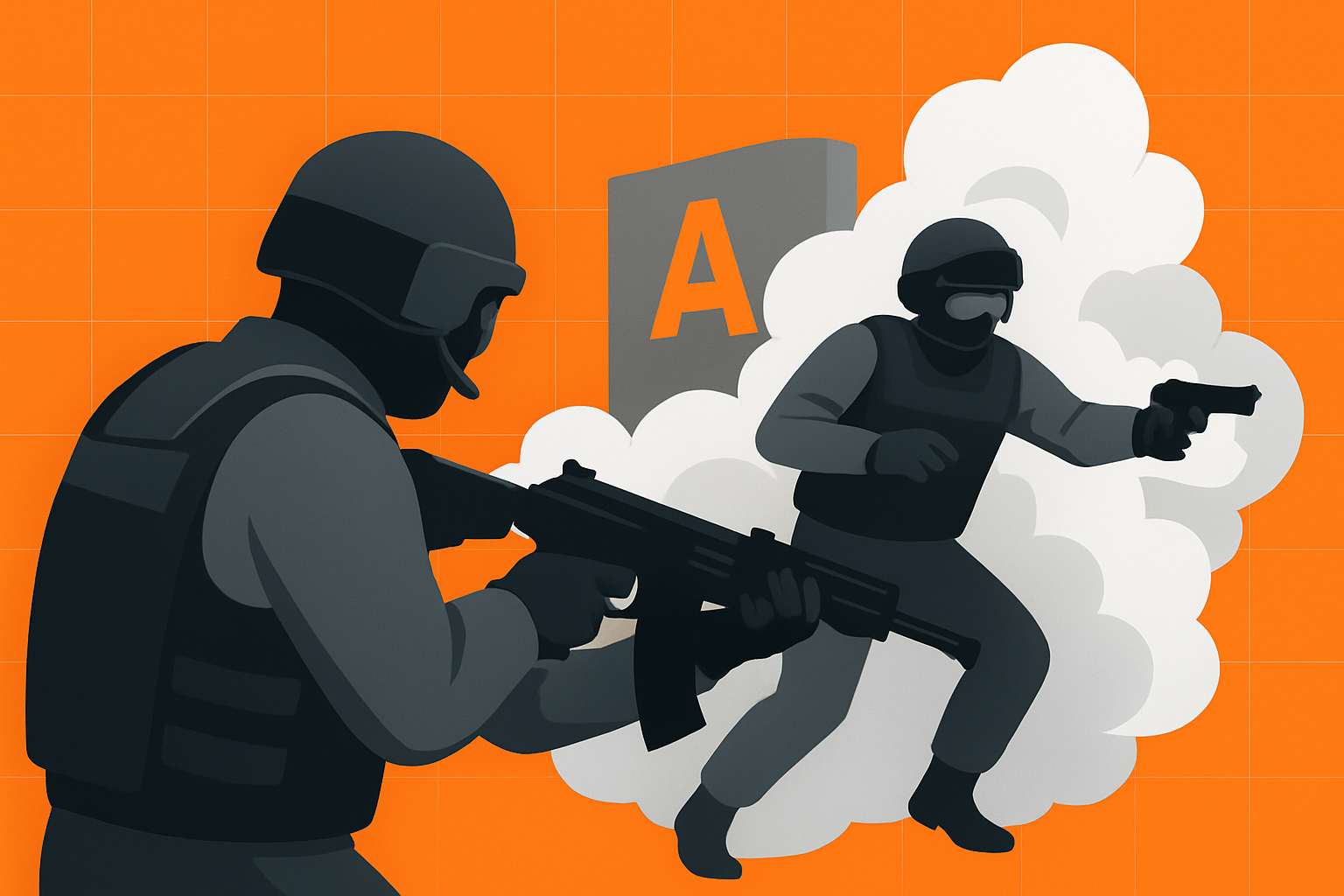
Bombsite executes fail when players arrive at the same choke point with different jobs, different timing, or an outdated assumption about what a smoke will block. Strong dynamic-smoke tactics work best when each player understands their role, the team has a plan for changing vision, and the entry is tied to what the defenders actually do.
This guide turns those principles into a practical framework for CS2 teams: assign responsibilities, plan an execute around smoke behavior, preserve trade potential, and make clear decisions when counter-utility or a fake changes the round. The goal is not to memorize one scripted rush. It is to coordinate a site take that can adjust without losing its structure.
Define team roles before planning a bombsite execute
An execute is a pre-planned attack on a bombsite, typically with substantial utility use; it is not simply a group sprint toward the site. That distinction matters because utility creates windows and responsibilities. If players do not know who takes space, who supports, and who remains available to punish a rotation, a well-placed smoke can still produce a disjointed hit.
Use roles as round responsibilities rather than permanent labels. A player may perform different jobs across a map or strategy, but the team should know who owns each task before the execute begins. HLTV’s role glossary describes the IGL as the caller, the entry as the first player challenging space, the lurker as a player disrupting from an off-angle or rotation route, the anchor as a site-holder, and the rotator as flexible support. Those distinctions provide a useful starting point for attack planning, too.
- IGL: Sets the plan, communicates the trigger to commit or pause, and updates the call when the defense reacts. The caller should make the decision understandable in a few words rather than adding a second, competing plan during the hit.
- Entry: Challenges the first contested space and creates an opportunity for the team to follow. The entry’s job is not to take every duel alone; the next player must be close enough to trade if the defender wins the first fight.
- Support: Delivers the utility that enables the entry, then follows at a spacing that preserves a trade. The support should know whether a smoke is intended to block a sightline, split the site, or cover a later plant position.
- Lurker: Applies pressure away from the main group, watches for rotations, or threatens defenders who leave their positions. Liquipedia describes the lurker as operating away from teammates to draw attention or pick off players rotating between sites.
- Flexible player: Adjusts to the information available, helps a stalled entry, or responds to a gap created by counter-utility. A flexible role is not permission to wander; it needs a defined trigger for joining the hit or changing the plan.
On defense, the same role vocabulary clarifies the problem the attackers need to solve. An anchor holds a site, while a rotator can shift to support another area. A smoke-fake works only if the pressure persuades defenders to move or spend utility; a lurker can make that rotation costly. When the attacking plan accounts for these jobs, players can read the defense as a system instead of treating every defender as an isolated target.
Make the trade structure explicit
Before the round, agree on who is first, who is second, and what the second player is expected to trade. The next player should not stop at the edge of the smoke to watch the entry fight from safety if the plan depends on immediate follow-up. At the same time, blindly following into a known defender’s line can turn a trade opportunity into two separated duels. Spacing and timing are decisions, not automatic consequences of running together.
Also identify who keeps an eye on the route behind the execute. That may be the lurker or a player assigned to watch a rotation path, depending on the plan. If everyone turns toward the site, defenders can potentially retake space behind the attackers without being challenged. The answer is not to leave a player isolated by default; it is to name the responsibility and define when that player rejoins.
Quick answer: assign the caller, entry, support, and rotation-pressure responsibilities before the round. Use smokes to create a controlled entry window, keep a trade player close to the first contact, and change the timing when bullets, grenades, or defender counter-utility alter the smoke.
Build the execute around a clear objective, not a pile of smokes
A smoke lineup is not the same thing as a complete execute. Before choosing utility, decide what the team needs to accomplish: block a defender’s view, divide the site, cross an exposed area, isolate a position, or protect the plant. One smoke may serve several purposes, but the team should agree on its primary job. If players interpret the same cloud differently, one may push while another waits for a second phase that was never called.
Write a basic plan in terms of actions and triggers. A useful sequence might be: establish pressure, deploy the planned smoke cover, send the entry when the caller gives the trigger, and let the support player follow for a trade. This is a framework, not a map-specific recipe. The actual locations, timing, and utility depend on the map, the team’s preparation, and what defenders reveal in the round.
- Set the objective. State which space or defender position the first utility is meant to affect. Avoid instructions that only name a grenade without explaining why it is being used.
- Assign the utility. Identify the player responsible for each required smoke or follow-up flash, and confirm who retains utility for a later problem. A plan that spends everything on the first visual barrier may have no answer to a retake or a stalled plant.
- Define the commitment signal. Choose a clear cue for the entry. It can be a call or an agreed event, but everyone should know whether the team commits when the smoke lands, when the next utility arrives, or after a defender is displaced.
- Set a fallback. Decide what the team does if the key smoke is mistimed, a defender pushes through, or counter-utility interrupts the route. The fallback may be to pause, re-smoke, pressure another area, or abandon the hit; it should be a team decision rather than five unrelated reactions.
- Plan the plant and next phase. Name who can plant safely and what the remaining players should cover. The site take is not complete when attackers reach the bombsite; the team still needs a plant and a defensible post-plant shape.
The caller’s job is to keep the plan legible as the situation changes. If a defender uses counter-utility to delay the hit, the team may need to wait, spend another resource, or redirect. If the defense gives up space, the attackers may be able to take it without using the entire planned sequence. The useful question is not “Did we throw every smoke?” but “Does the current state still support the original objective?”
Role discipline gives the team a way to make that choice quickly. The entry can report whether the route is clear or contested; support can confirm whether the intended cover is present; the lurker can report pressure or a rotation; and the IGL can call whether to continue. This short information loop is more valuable than several players making separate guesses about the same cloud.
Use dynamic-smoke tactics to manage vision and timing
CS2 smoke grenades are more dynamic than static visual barriers. HLTV has reported that they react when bullets pass through them and can be briefly dissipated by grenades. That behavior affects both sides: attackers cannot assume a smoke will preserve the same cover throughout an entry, while defenders can use shots or utility to challenge the protection it appears to provide.
Plan the smoke as a temporary condition the team must manage, not as a permanent wall. A smoke may block vision at first, then change as players shoot through it or a grenade disrupts it. The practical response is to coordinate movement with the state of the smoke and to be ready for that state to change. Do not build a plan that requires every player to cross at an exact moment unless the team has practiced the timing and has a clear response to disruption.
Give each smoke a job and an expiration plan
For every important smoke, answer three questions: what view or route is it meant to affect, who acts while it is active, and what happens if it becomes unreliable? For instance, a smoke can give an entry a window to challenge space while a support player follows. If a defender shoots through it or a grenade briefly clears it, the team should know whether the entry continues, pauses for replacement utility, or changes route.
This does not mean attackers should treat every bullet or grenade as proof that the smoke has failed. It means the team should notice the interaction and base its next move on the new information. A smoke that briefly opens may reveal where defenders are shooting from, but that information is useful only if someone can communicate it and the team has a response.
- For the entry: Watch for a sudden sightline change before crossing or committing to a duel. The smoke may still offer some concealment, but the initial visual condition cannot be assumed to hold unchanged.
- For support: Be ready to follow the entry or provide replacement utility if the planned cover is disrupted. Avoid starting a separate action so late that the first player is left without the intended trade.
- For the caller: Listen for concise updates about a smoke opening, a grenade interaction, or shots through the cloud. Use those updates to choose between continuing, pausing, and redirecting.
- For defenders: Treat a smoke as an opportunity to delay or challenge, not as a reason to surrender all influence over the area. Counter-utility and disciplined timing can disrupt an execute, though attackers may be expecting that response.
The timing trade-off is real. A fast entry can use the initial cover before defenders have time to react, but it can also arrive before supporting utility or trade players are ready. Waiting can align the team and create more information, but it gives defenders time to contest or alter the setup. The right choice depends on the plan and the signals available in that round, not on a universal rule to always rush or always wait.
Communicate smoke changes in actionable language. “Smoke is gone” is useful if it is accurate, but a more precise call can distinguish a full opening from a brief disruption or a shot coming through the cloud. Keep the call short enough that it does not obscure other information. The team needs to know what changed and whether the entry is still committed.
Time the entry to preserve space, support, and trades
The entry creates the first contest for space, but the value of that contest depends on the rest of the team. HLTV’s role guidance emphasizes the entry, support, lurker, and IGL working together to win space and secure a plant with minimal resistance. In practical terms, that means the first player should not be treated as a disposable probe whose information arrives only after the team has lost its chance to trade.
Set the entry order in advance. The first player challenges the planned space; the second player follows closely enough to punish a defender who focuses on that first duel; the next player supports with utility or covers a different angle according to the call. The exact formation should reflect the route and expected resistance. A tight follow-up can improve trade potential, while a cluster can become vulnerable to the same area denial or utility. Teams should choose spacing deliberately rather than assume that closer is always better.
Choose when to cross, not just where to cross
Use a commitment trigger that fits the utility sequence. If the plan depends on a smoke and a flash arriving together, the entry should know whether to move on the smoke, wait for the flash, or act on a call from the IGL. If the team has already decided that a defender’s counter-utility will prompt a pause, the entry should not interpret that pause as permission to take a solo fight.
There are two broad options when the opening is uncertain. The team can commit with the first usable window, accepting that defenders may still contest the site, or it can delay long enough to restore coordination and reassess the defense. Committing can preserve initiative; delaying can keep the team from entering a broken setup. Neither approach is automatically safer. The cost of delay is time and a chance for the defenders to reset, while the cost of commitment is entering without the support the original plan expected.
Keep information moving between the first contact and the rest of the group. The entry can report whether a position was cleared, whether a defender is present, or whether the route is blocked. The support player should be positioned to act on that report, not simply repeat what the entry sees. The IGL then decides whether to trade, add utility, or shift the plan. This makes the team’s response faster without requiring every player to speak at once.
Trade-frag structure also affects the plant. Once the entry has created a path, avoid sending the entire team after the same defender while leaving the bomb carrier exposed or the approach to the plant unprotected. Assign a player to the plant and give the others distinct responsibilities: contest the remaining site space, watch a likely approach, or retain the route that matters for a retake. The right positions vary by map, but the need for explicit jobs does not.
When the first player is eliminated, make the next decision quickly. If the follow-up can trade, take that duel with support rather than waiting until the defender has reset. If the trade is no longer available, communicate that the entry has stalled and let the caller decide whether to continue. A silent pause can leave the team stacked at the same bottleneck with no pressure elsewhere.
Use fakes and lurkers to influence rotations
A fake is pressure designed to persuade defenders to rotate to a site the attackers do not intend to take. Liquipedia describes fakes as using noise together with flashes and smoke grenades to create that impression. A smoke-fake is therefore more than a spare grenade thrown at a distant area: it needs enough supporting pressure to look credible, and the main group needs a plan for acting on the reaction.
Use the lurker to make the fake matter. A lurker can threaten a route between bombsites, draw attention, or punish a defender who rotates without checking the space. That pressure can make it harder for the defense to move freely while the main group prepares a site hit. The lurker should understand whether their job is to remain unseen, take a specific timing, hold a route, or join the execute after a signal.
Make the fake credible without spending the real execute
The main group should decide how much utility and noise the fake requires before the round. If the fake consumes the smokes, flashes, or time needed for the actual hit, it may create a rotation that the attackers cannot exploit. Conversely, a token sound with no follow-up pressure may fail to affect the defense. The team should weigh credibility against the resources reserved for the main plan.
Set a trigger for ending the fake. That could be an observed rotation, a defender using counter-utility, or a timing chosen by the IGL. If the expected response does not happen, the team must decide whether to keep applying pressure, abandon the fake, or move into a different plan. A fake is not successful simply because utility landed; its tactical value comes from creating a useful response or preserving uncertainty for the defense.
There is also a trade-off in how much the lurker reveals. More visible pressure can make defenders more likely to react, but it can also expose the lurker and reduce the threat to rotation routes. Less visible pressure can preserve surprise, but may not convince defenders to move. The caller and lurker should agree on the desired effect and communicate whether it has been achieved.
Do not confuse a fake with a guaranteed rotation. CTs can use counter-utility to slow site hits and may choose to hold rather than leave a site. Attackers should treat defender movement as information, not as a result they are entitled to. If the defense does not rotate, the main group still needs a sound execute; if it does rotate, the lurker and caller should identify whether the new space is actually safe to take.
Plan for counter-utility, fire, and retake pressure
CT counter-utility is a direct answer to a site hit. HLTV notes that defenders use utility to stop executes and keep attackers at bay, while attackers can fake one site with smoke and flash pressure before hitting another. This makes utility management a contest between teams: attackers want to create a window, and defenders want to delay, divide, or disrupt the approach.
Build a response to delay into the execute. When counter-utility interrupts the timing, decide whether to wait for the blockage to clear, use a remaining resource, pressure another area, or cancel the hit. Avoid sending one player into the delay while the rest of the team is still waiting, unless that isolated action is an intentional probe with support. The team should understand what information the probe is meant to gather and how it will be traded or recovered.
Fire adds a specific interaction to the utility plan. The Counter-Strike Wiki notes that in CS2 a smoke releases instantly on contact with Molotov or Incendiary flames and extinguishes the fire. Teams can account for this on both attack and defense: a smoke may clear a burning area, while fire can shape movement and delay a route before that interaction occurs. Do not assume the smoke and flames will remain as two independent barriers after they meet.
That interaction creates choices, not a guaranteed advantage. An attacker may use smoke to extinguish flames and cross, but the move can also reveal timing or consume utility needed elsewhere. A defender may use fire to disrupt an approach, but the smoke interaction can remove the fire. The caller should consider what each player is trying to accomplish at that moment: deny movement, create a crossing window, force a resource, or buy time.
Carry utility value into the post-plant
The bombsite take is only one phase of the round. Smoke can conceal the planted C4 or the defuser, and post-plant smokes can strengthen the attackers’ hold. Decide before the hit which utility is reserved for that phase. A team that spends every smoke to enter may have fewer options for controlling vision after the plant, while saving too much can make the initial site take harder.
Assign post-plant jobs as soon as the team commits to planting. One player should be responsible for the plant when the site is sufficiently controlled; others should cover distinct approaches or hold space that matters for the retake. If a smoke is intended to conceal the bomb or complicate a defuse, coordinate its use with the team’s ability to observe and challenge the retake. A smoke can obscure vision for both sides, so its value depends on where teammates are positioned and what they can still monitor.
Defenders face a similar set of choices during a retake. Counter-utility can delay attackers or split their attention, and a smoke can affect visibility around the bomb. A retaking team should coordinate its approach rather than allow one player to enter a cloud while teammates remain disconnected. It also needs to account for the possibility that smoke and fire interact, changing which routes are blocked or available.
Make the post-plant call from current information. If the attackers have a stable hold, they may prioritize preserving positions and trading rather than chasing every defender. If the defenders have regained access to important space, the team may need to adjust the setup or use saved utility. The specific positions depend on the map and the remaining time, so rehearse the logic and responsibilities rather than relying on a single fixed hold.
Adapt the plan to map control and changing site dynamics
Map knowledge is part of role discipline. Recent HLTV coverage has described professional players emphasizing knowledge of positions and the ability to execute specific strategies as ways teams adapt faster in CS2. Players need to know more than a smoke’s landing point: they should understand what space it affects, what routes remain open, and how the team’s jobs change if the defense contests a different area.
Map changes can alter the value of an old timing or assumption. Liquipedia’s Nuke page notes that Valve adjusted rotation times between stacked bombsites and changed lower-site dynamics to make securing the site more dynamic for both sides. That is a reminder to review how a plan interacts with the current map rather than carrying over a strategy unchanged because its utility sequence used to work.
For each prepared execute, record the decision points that depend on map control. Identify what space the team must retain to keep its options open, which route the lurker threatens, and what information would justify shifting from one site to the other. This keeps the plan useful when the defense contests an unexpected area. It also reduces the risk that players treat a memorized utility sequence as a command to continue regardless of the situation.
- Review the route: Confirm that players know how the entry reaches the intended space and where support can maintain trade distance.
- Review the rotation threat: Check whether the lurker’s route can apply pressure or gather useful information without becoming disconnected from the round.
- Review the timing: Consider whether the team can arrive together after the utility sequence, especially when the defense can contest or rotate between areas.
- Review the alternative: Define what the team does if the route is blocked, the smoke changes, or the defense refuses to react to a fake.
Keep map-specific calls precise but not overloaded. A player should know which position or space is being referenced and what action follows from the information. Avoid building a plan around obscure shorthand that only one caller understands. Shared language makes it easier for substitutes, coaches, and technical staff to review a round and identify whether the plan failed in execution, timing, or decision-making.
Practice and review executes as a team system
Practice should test more than whether each player can reproduce a utility throw. A team can learn a smoke lineup and still fail to execute if the entry leaves before support is ready, the caller gives no response to counter-utility, or the lurker does not know when to join. Treat the execute as a sequence of linked responsibilities and rehearse the transitions between them.
Rehearse the intended sequence and its failure cases
Start by practicing the standard version of the hit: utility assignments, commitment cue, entry order, trade spacing, plant responsibility, and post-plant setup. Then rehearse variations that challenge the plan. For example, agree how the team responds when the smoke is disrupted, when defenders delay with utility, when a fake does not draw a rotation, or when the entry loses the first duel without an immediate trade.
These are not claims about a universal best response. They are practice prompts that help a team choose its own response before pressure arrives. The purpose is to make the decision familiar enough that players can act together rather than negotiate the whole round in real time. Keep the fallback simple; a complicated branch that no remembers is not a reliable fallback.
Use short review questions after practice or competition. Did the intended utility create the space the team wanted? Did the entry have a trade player in position? Did the caller receive and use information about the smoke or counter-utility? Did the fake influence defender behavior, and did the lurker have a useful next action? Did the team retain utility or positions for the plant and post-plant?
Separate execution mistakes from planning mistakes. If the team called a valid plan but a player mistimed a throw, the fix may be repetition and clearer ownership. If the smoke did not serve the intended purpose, or the team had no response to a predictable counter, the plan itself needs revision. This distinction keeps reviews actionable and prevents teams from changing a sound strategy after every lost round.
Coordinate the competitive environment
For teams and platform staff, the practice environment should let players evaluate timing and communication consistently. Agree on the server and match settings used for team practice, keep the test conditions clear to participants, and ensure that everyone reviewing a round is looking at the same gameplay record. These are operational practices, not guarantees that any particular infrastructure will improve a result.
When reviewing a round, include the voices of the people responsible for the call and the utility plan, not only the player who took the first duel. A single failed entry can be caused by a missing flash, a late follow-up, an incorrect commitment cue, or a defender’s counter-utility. Team-level review is more likely to identify the actual break in the sequence than judging the outcome from the first kill alone.
Useful performance review should examine coordination as well as individual mechanics. HLTV tracks teamwork and utility categories in its CS2 team statistics, and lists teams such as Spirit, Vitality, and NRG alongside those indicators. Those categories underline that team performance is not reducible to aim alone; they do not, by themselves, prove why a particular execute succeeded. For an individual team, use its own round review to connect outcomes to decisions and execution.
Keep the review focused on repeatable improvements. If the team repeatedly enters before its supporting utility, change the cue or sequence. If the lurker’s pressure arrives too late to affect rotations, clarify the timing or choose a different responsibility. If defenders consistently disrupt the same smoke, test an alternative timing or route. Update the plan when the evidence suggests a change, then practice the revised version before relying on it in competition.
Turn roles and smoke behavior into a repeatable advantage
Reliable site takes combine clear roles with flexible execution. The IGL gives the team a readable plan, the entry challenges space, support preserves the utility and trade structure, and the lurker pressures rotations or protects the team’s options. Dynamic CS2 smokes add another variable, so teams should plan for changing vision instead of treating a smoke as an unchanging wall.
Use one practical test for every execute: can each player explain their job, the trigger to act, and the next response if the smoke or defense changes? If the answer is yes, the team has a framework it can rehearse, review, and adapt to the map. Keep the plan specific enough to coordinate the hit, but flexible enough to respond to counter-utility, shifting rotations, and the demands of the post-plant.